Halley: Ambassador Robot 001
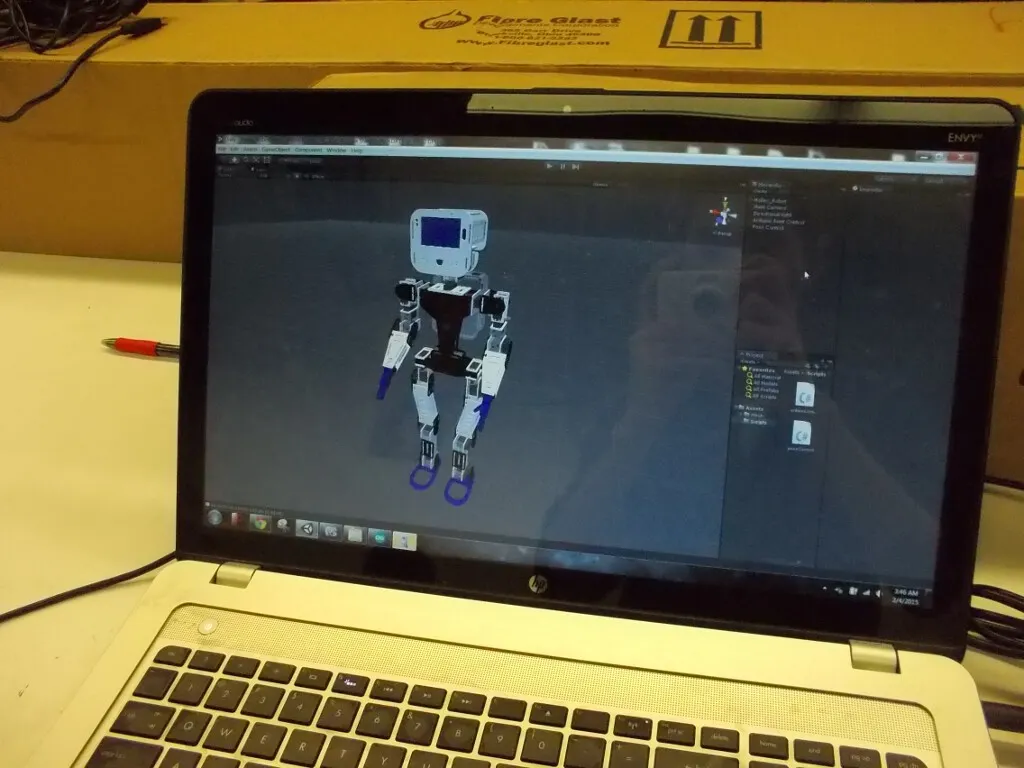
A 2.6-ft laser-cut humanoid robot with 21 metal gear servomotors and an Android phone for a face, built to explore human-robot interaction and serve as a remote student proxy in university classrooms. Supported by a microgrant from the Frank-Ratchye Fund for Art @ the Frontier.
Overview
Ambassador Robot No. 001, also known as Halley, is a 2.6-foot humanoid automaton built for the sole purpose of exploring what it means to be human from a non-human perspective. The primary means of achieving this is through human-robot interaction, where Halley emulates as many human functions as possible while interfacing with another person.
A humanoid shape of respectable size is deemed necessary for authentic human connection, along with an array of face-to-face communication techniques:
- A speaker, camera, and microphone for basic sensory input and output
- Movable arms and legs to support gestures such as raising a hand to ask questions
- An Android phone as a face, allowing a wide range of expressive emotions to be displayed
The ultimate goal: to have Halley take the place of a student in a classroom — attending and recording university lectures as a remote proxy.
Hardware
- Arduino Mega 2560
- Samsung Galaxy Light SGH-T399 (Android phone face)
- AUVIO Universal Portable Speaker 4000372
- 21× Power HD-1201MG metal gear servomotors
- Plugable USB 2.0 7-Port Hub w/ 3A Adapter
- 5V 10A switching power supply
- 3.0mm laser-cut acrylic frame
- 3D-printed hands & feet
Fully reproducible for around $500–800.
Software
- Unity3D, Arduino, RhinoCAD, Autodesk Maya, Google Translate
Built entirely in the CMU Robotics Club workshop.
Recognition
The Halley Instructable received more than 23,000 views. Graduate students and a tech professor at various institutions expressed interest in replicating the project. The Poppy Project — a team of roboticists in France who inspired this work — were impressed enough to consider merging Halley’s contributions with theirs.
Support & Affiliations
- Frank-Ratchye Fund for Art @ the Frontier (FRFAF) — microgrant supporting the build
- CMU Robotics Club — workshop space and community
- Poppy Project — open-source humanoid robotics inspiration
All source files are open-source under GNU GPL v2.0 on GitHub.
Gallery
.webp)
.webp)
.webp)
.webp)
.webp)
.webp)
.webp)
.webp)
.webp)
.webp)
.webp)
.webp)
.webp)
.webp)
.webp)
.webp)
.webp)
.webp)
.webp)
.webp)
.webp)
.webp)
.webp)